
A realistic limb lengthening before and after shows a permanent height increase of about 5–8 cm from a single procedure, or up to roughly 13–16 cm from a two-stage plan — not the dramatic transformations clinic galleries imply. The most important thing to understand about before-and-after photos is that the two images are taken 12 to 18 months apart, and that most published galleries are marketing: cherry-picked best cases, shot to flatter. Here is how to read them honestly.
What a realistic before and after actually shows.
Strip away the marketing and the realistic picture is consistent. A single femur or tibia lengthening adds about 5–8 cm; a systematic review of cosmetic stature lengthening put the average gain around 67 mm — call it 6 to 7 cm. A two-stage plan that lengthens both the femur and the tibia in separate operations can reach roughly 13–16 cm at the upper end, but that is two surgeries, two recoveries, and a higher risk profile, not a single dramatic leap.
In a genuine before-and-after, the change is real but proportionate: a few centimetres to a hand's width of extra height, permanently. It is enough to move someone meaningfully up the height distribution, which for many patients is the entire point. It is not enough to make a short person tall in one operation, and any image suggesting otherwise is either a two-stage result presented as one surgery or a photographic trick.
The exact number you can realistically expect depends on your bones, your method, and whether you do one segment or two — we break the limits down in detail in how much taller can you actually get. Use that as the anchor for what a believable before-and-after should show, and treat anything well beyond it as a red flag rather than an aspiration.
It is not just height — your proportions change too.
A before-and-after photo shows a taller person, but it does not show the part that some patients notice most: the change in proportion. Limb lengthening adds length to the legs only. The torso stays exactly the same.
For a modest gain, this is invisible — the new proportions sit comfortably within normal human variation. At the upper end of a two-stage plan, the leg-to-torso ratio shifts further, and while many patients are happy with longer-looking legs, it is something to picture honestly before committing rather than discover afterwards. A good before-and-after assessment looks at the whole silhouette, not just the height number.
This is one reason the realistic-results conversation and the how-much-taller conversation are the same conversation. The centimetres you choose are also a proportion decision. Patients who think only about the height number, and not about how those centimetres distribute across their frame, are the ones most likely to be surprised by their own after photo.
Why most clinic before-and-after photos are marketing.
Here is the uncomfortable truth the galleries will not state: a clinic's before-and-after collection is a sales tool, and it is built to sell. That does not make every image dishonest, but it does mean you should read them like advertising, because that is what they are.
The standard techniques are easy to spot once you know them. The "before" is often shot in flat lighting, slouched posture, and flat shoes; the "after" gets better lighting, straighter posture, and sometimes footwear that adds a little more. Camera angle and lens choice change apparent height. And every gallery is survivorship-filtered: you are seeing the clinic's best outcomes, never the patient who had a complication, a slow union, or a result at the low end of the range.
None of this is unique to limb lengthening — it is how cosmetic before-and-afters work across the industry. But limb lengthening is a six-figure, year-long, genuinely risky decision, so letting a marketing gallery set your expectations is more costly here than almost anywhere else. The realistic complication picture that those galleries omit is on our complications page, and the honest version of the recovery they compress into two photos is in our recovery timeline.
How to read a before-and-after honestly.
You can extract real signal from before-and-after images if you read them critically. A trustworthy comparison holds the variables constant and shows its work:
Same conditions. Same footwear (ideally barefoot), same posture, same camera distance and angle, same lighting in both photos. Any difference in these is doing some of the "height gain" for free.
A measurement reference. A height chart, a doorframe, a marked wall — something objective in both frames. A number with no reference is a claim, not evidence.
The full case range, not the highlight reel. Ask the surgeon to show typical results, not only the best ones, and to state the gain in centimetres for the specific images. A surgeon who will show you a middling result alongside a great one is being more honest than one with only flawless galleries.
The timeline. Remember the two photos are 12–18 months apart, and that the months in between were distraction, consolidation, and daily physiotherapy. The after photo is the end of a long, demanding process — not a quick result. The pain across that gap is covered honestly in how painful is the surgery.
Where to see honest before-and-after evidence.
If marketing galleries are the least reliable source, what is the most reliable? Two things.
Patient video diaries. Long-form, patient-uploaded recovery diaries that run from surgery through the full recovery are far closer to ground truth than a clinic's two-photo gallery, because they show the whole arc — the bad weeks, the physiotherapy grind, and the real end result. They are not edited to sell. Several are referenced from our recovery timeline.
Verified, named clinics. A surgeon willing to discuss their full range of outcomes — in a documented video consultation, with results stated in centimetres — is worth more than any gallery. The clinics in this directory are verified for named surgeons, credentials, and methods, with no paid placement, so you can start from a checked shortlist rather than a marketing page.
The honest summary is simple: a limb lengthening before and after is a real, permanent, proportionate height gain earned over a hard 12–18 months — not the effortless transformation a gallery implies. Anchor your expectations to the realistic numbers, read every before-and-after as the advertisement it is, and weigh the whole decision — including whether it is worth it — before the photos do your thinking for you.
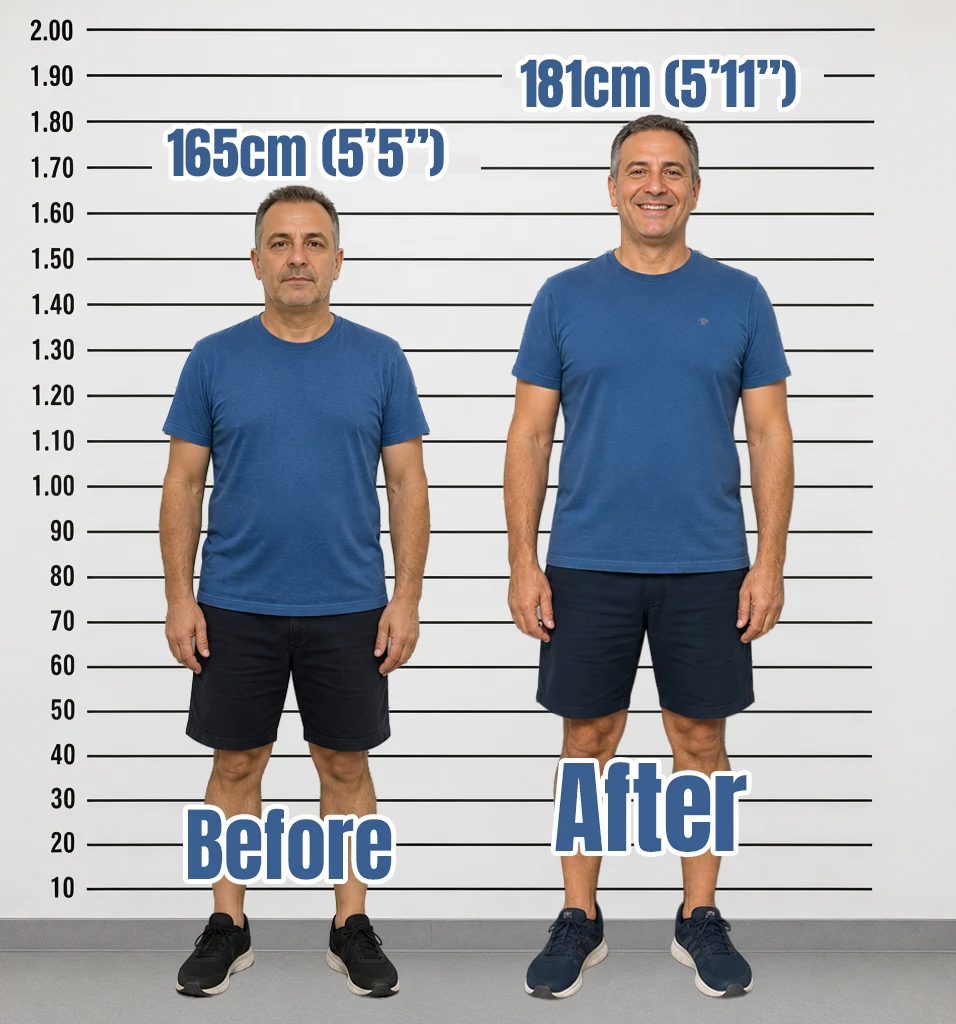
- ·A realistic limb lengthening before and after shows ~5–8 cm from one surgery, or up to ~13–16 cm from a two-stage plan — not a one-operation transformation.
- ·The two photos are taken 12–18 months apart; the after image is the end of a long recovery, not a quick result.
- ·Most clinic before-and-after galleries are marketing: cherry-picked best cases, with posture, footwear, lighting, and camera angle doing some of the work.
- ·Limb lengthening adds length to the legs only — the torso stays the same, so proportions shift, most noticeably at the upper end of a two-stage plan.
- ·Read a before-and-after honestly: same footwear/posture/lighting, a measurement reference in both frames, the full case range (not just the best), and the centimetre gain stated.
- ·Patient video diaries and verified named surgeons are more reliable evidence than any two-photo marketing gallery.
Quick answers
What does limb lengthening before and after look like?+
A realistic before-and-after shows a permanent height increase of about 5–8 cm from one surgery, or up to roughly 13–16 cm from a two-stage plan. The change is proportionate and real, but it is not the dramatic one-operation transformation that marketing galleries imply, and the two photos are 12–18 months apart.
Are limb lengthening before and after photos real?+
Some are, but they are marketing first. Galleries show cherry-picked best cases and often use posture, footwear, lighting, and camera angle to flatter the after image. Patients with complications or low-end results are not shown. Read them as advertising and ask the surgeon for the full range of outcomes.
How long between the before and after photos?+
Typically 12 to 18 months. The before is taken around surgery, and a genuine after is taken once distraction, consolidation, and physiotherapy are complete and the patient has returned to normal activity. A short gap suggests the result is not yet final.
Does limb lengthening change your body proportions?+
Yes — it lengthens the legs only, so the torso stays the same and the leg-to-torso ratio shifts. For a modest gain this is invisible within normal variation; at the upper end of a two-stage plan it is more noticeable, which is worth picturing honestly before committing.
How much height can you realistically gain?+
About 5–8 cm from a single femur or tibia lengthening (a systematic review put the average near 67 mm), and up to roughly 13–16 cm from a two-stage femur-and-tibia plan at the upper end. Claims of 10 inches from one operation are not realistic.
Sources
- 1.Cosmetic stature lengthening: systematic review of outcomes and complications (PMC7342054) — Average height gain (~67 mm) and outcome data underpinning realistic results
- 2.Aesthetic lower limb lengthening techniques: a systematic review of efficacy, complications, and patient satisfaction (J Orthop Surg Res, 2025) — Efficacy and gain ranges across cosmetic lengthening techniques
- 3.AAOS OrthoInfo — Limb Lengthening (patient resource) — Consumer overview of the lengthening process and expected outcomes
- 4.Lin CC et al. Cosmetic Lower Limb Lengthening by Ilizarov Apparatus: What are the Risks? (PMC4182395) — Complication context omitted from marketing galleries
Get matched with a verified clinic.
Our editor reviews your inquiry and introduces you to 2–3 clinics that fit your budget and goals. First clinic consult is usually free. We never sell your data.
Get matched — free →